What TikTok Shop in Europe is and how in-app selling works
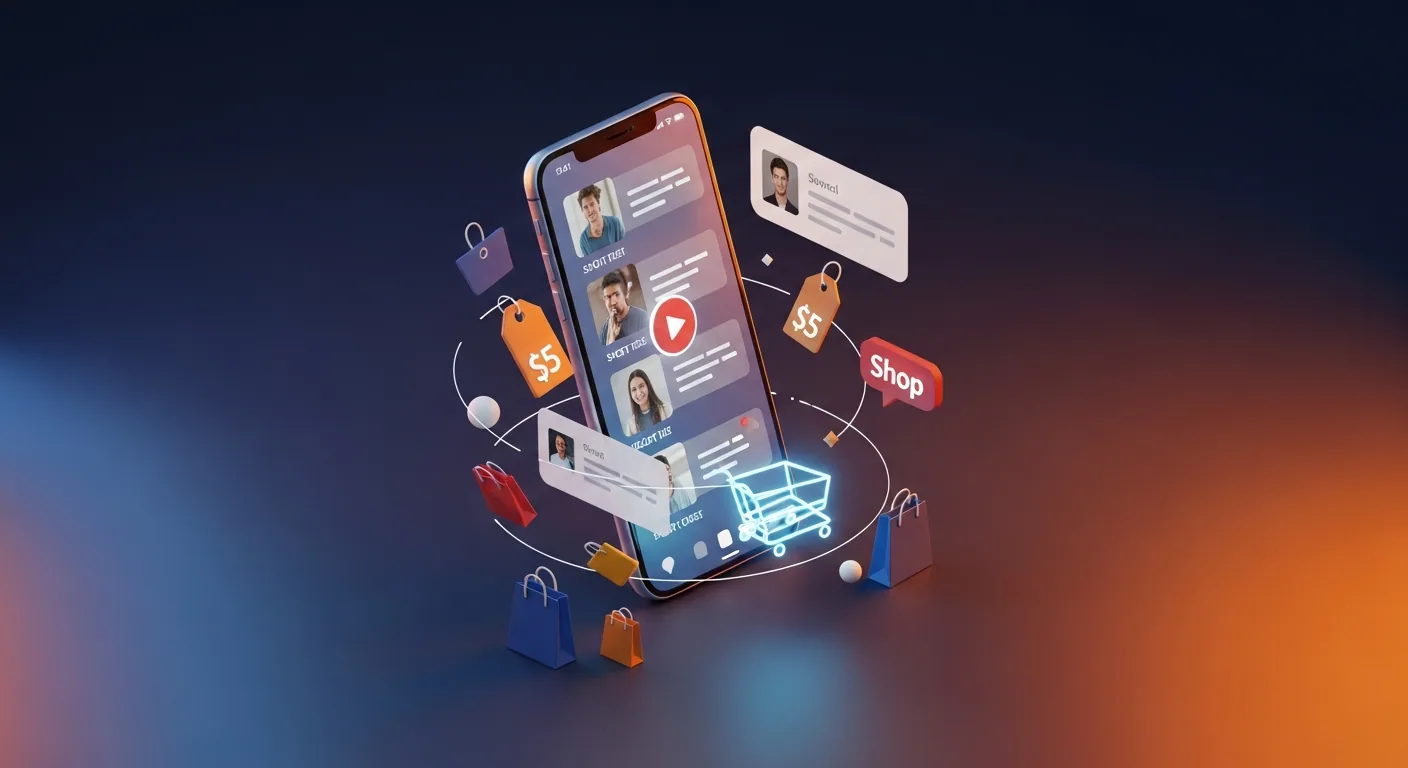
TikTok Shop is a shopping platform built into the TikTok app, expanding across Europe market by market, that lets people buy and sell without leaving the feed. Selling happens in three places: videos with a tagged product, live streams (LIVE Shopping) and a permanent 'Shop' tab. For brands it is a new social commerce channel where the product reaches the customer mid-scroll, before they land on a website. This section explains the TikTok Shop model and the EU rollout order.
TikTok Shop: buying without leaving the feed
In-feed buying runs on discovery commerce: the product finds the customer while they scroll, rather than the customer searching for the product. The algorithm surfaces offers matched to interests, and the whole path (watching a video, the cart, payment, shipping) happens inside the app, with local payment and courier options per country. This shortens the buying journey to a few taps and lifts impulse conversion on TikTok Shop. That is why in social commerce products whose effect shows on video in seconds sell best, as the summer 2026 social media trends also show.
TikTok Shop EU rollout order and market lag
TikTok Shop reaches EU markets in waves, not all at once: after the UK it opened Spain, Ireland, Germany, Italy and France, then Poland on 15 June 2026 alongside Austria, Belgium and the Netherlands. Each launch is a full commercial start, with in-video, live and shop-tab buying available from day one. If your market is not live yet, the lag is an advantage, because the fundamentals below (catalogue, margin, content plan) can be prepared now. Brands present at Poland's launch included L'Oréal, Eveline Cosmetics and beBIO.
TikTok Shop is one of the fastest-growing shopping channels, where product discovery and purchase happen in the same place.
Who can sell on TikTok Shop across the EU
Any registered business with a local VAT ID can sell on TikTok Shop, with no follower threshold. This is the most common misconception: the 1,000 or 5,000 follower requirement applies to creators in the affiliate programme, not to sellers with their own store. Below we cover the formal requirements and the products you cannot list. Start by checking that your company and catalogue meet the platform's rules in your country.
Formal requirements for a TikTok Shop seller
To open a seller account you need a registered business, an active VAT ID and a company bank account matching your registration details. Verification covers your registration documents and the identity of the person opening the account, and settlement assumes active VAT status. For multi-country EU sellers, each market may require a local entity or VAT registration. The minimum set looks like this:
- A business registered in the EU market you sell into (sole trader or company).
- A VAT ID and active taxable status: sales are taxed at the local rate.
- A company bank account with a name matching your registration 1:1.
- ID of the person representing the company for account verification.
- No follower threshold: the 1,000/5,000 rule applies only to affiliate creators.
Prohibited and regulated products on TikTok Shop
Before you list, check that the product is not in a prohibited or regulated category, because breaking the rules ends in an account ban. TikTok Shop fully bans whole groups of products, while some categories are allowed only after you supply certificates. EU law applies regardless of the platform: GPSR product safety, WEEE/EPR duties and the Omnibus directive. The list of bans is wider than most expect, so we set it out below:
- Weapons, ammunition, explosives and pyrotechnics, plus replica firearms.
- Drugs and legal highs, alcohol and tobacco, including e-cigarettes and vape liquids.
- Prescription medicines, steroids, and supplements for children or with banned substances.
- Hazardous chemicals, corrosive and toxic reagents, and plant-protection products.
- Gambling products and services: lotteries, betting, coupons and game-of-chance codes.
- Law-breaking tools: lock picks and key-copying kits, security-bypass devices, trackers and spy gear.
- Counterfeits and goods infringing copyright or trademarks.
- Adult content, live animals, financial products and cryptocurrencies.
- Regulated (documents required): cosmetics, electronics, medical devices, toys and baby products.
How to start selling on TikTok Shop step by step
Starting on TikTok Shop takes a few stages: register the seller account, configure the store and shipping, and connect your product catalogue to the system you already run. Order matters, so handle formalities and logistics first, then integration and the first campaigns. Below we show both layers: manual setup and automatic sync with your e-commerce. Work through them before you switch on promotion.
Registration and store setup on TikTok Shop
You start registration in Seller Center, where you open a company account, pass verification and set shipping and returns. TikTok Shop integrates with local carriers and payment methods per market, which keeps logistics setup light. The next steps:
- Open a Seller Center account and pass business verification (VAT, registration, bank account).
- Set shipping methods and a returns policy consistent with the EU withdrawal right.
- Add products manually or via integration, with titles, photos and stock levels.
- Connect payments and test the full purchase path on a single product.
Connecting TikTok Shop to your online store
If you already run a store, do not list products by hand, but connect the catalogue via an integration so stock, prices and orders sync automatically. It works best where sync is two-way: the offer goes to TikTok Shop and orders return to your system. We implement and maintain that connection as part of our e-commerce service. The most common integration paths:
- Shopify: the most advanced integration, with rich catalogue management.
- BaseLinker: two-way flow of offers and orders, popular across CEE e-commerce.
- IdoSell: native integration in supported markets, syncing the offer in minutes.
- Custom platforms via API with webhooks and polling.
Logistics requirements and shipping on TikTok Shop
Logistics on TikTok Shop is a hard condition for keeping your account, because the platform enforces dispatch times, order completeness and smooth returns. Orders must be shipped within a set window (usually 1–2 business days), or cancellations rise and your seller rating drops. Carriers and the return window follow local rules, and EU customers keep at least a 14-day right of withdrawal. Below we split logistics into two layers: order handling and the creator sample programme.
Shipping and order-handling standards on TikTok Shop
You keep the seller account only by meeting shipping standards, because TikTok Shop measures dispatch time, cancellation rate and complaint volume. Three things are critical: on-time dispatch, correct labels and tracking numbers uploaded to the system, and a ready 14-day returns process. At higher volume, consider fulfilment and a third-party warehouse to hold delivery times as you scale. We wire the whole order flow into your ERP and CRM through marketing automation.
- Dispatch window: usually 1–2 business days from order placement.
- Tracking: parcel number and label uploaded to Seller Center for every order.
- Returns: process and return address ready before launch, minimum 14-day EU withdrawal.
- Scaling: fulfilment or a 3PL warehouse as order volume grows.
The creator sample programme on TikTok Shop
The sample programme lets you send a creator a free product so they record content and start affiliate sales before you pay any commission. It is a low entry cost, because instead of an upfront budget you only bear the product and sample shipping. Send samples to creators who fit your category rather than the largest by reach, because fit, not reach, drives sales. Plan a sample pool as part of your content budget, alongside photo and video production.
What selling on TikTok Shop actually costs
Selling on TikTok Shop costs far more than the transaction commission alone, because the real channel cost stacks commission, ads, affiliate fees, returns and logistics. Commission starts at a promotional 2% and rises to a standard 9%, but that is only one component. Below we separate the platform commission from the full cost stack you must build into margin. We calculate that margin properly as part of an ad audit and strategy.
TikTok Shop commission and the 2% promotional period
New sellers pay 2% commission for the first 90 days, and after the promotional period the rate rises to 9% (and 7% for electronics). Commission is charged on a broader base than the product price alone, so the real markup can be higher than the percentage suggests. Beware the '4% for 60 days' claim, because those are mature-market EU5 terms, not universal. Treat the 2% window as time to test the channel before target rates apply.
The real TikTok Shop cost stack
Add GMV Max ads, creator affiliate fees, returns and logistics to the commission, because on mature markets the total cost of selling reaches 35–55% of revenue. The breakdown below shows typical shares of each component in sales revenue. The takeaway is simple: product margin must survive the whole stack, not just the platform commission. That is why low-margin products rarely deliver a result on TikTok Shop.
The real TikTok Shop cost stack (share of revenue). GMV Max ads: 20%; Affiliate (creator fee): 15%; Platform commission: 9%; Returns: 8%; Logistics and content production: 5%.
Indicative shares on mature EU markets. The components combined can reach 35–55% of revenue.
How to promote products on TikTok Shop: ads and creators
Promotion on TikTok Shop rests on two levers: paid GMV Max campaigns and working with creators in the affiliate programme. Both share one truth, because they only work on good video: content, not the product itself, drives sales. Below we show how to run the ads, how to structure creator collaboration and which products actually convert. At the end you will find an entry checklist.
GMV Max ads on TikTok Shop
GMV Max has been the single sales-campaign format since mid-2025, and it replaced earlier product ads and video shopping ads. You set a daily budget, an ROI goal and products, and the system picks creatives, audiences and placements itself, with a ROI Protection mechanism. Campaigns run in two variants, depending on whether you drive the catalogue or live streams. We run and optimise those campaigns as part of our paid media service.
- Product GMV Max: a sales campaign driven by your product catalogue.
- LIVE GMV Max: a campaign driving sales inside live streams.
TikTok Shop Affiliate: working with creators and influencers
TikTok Shop Affiliate is the programme where creators promote your product for a commission on sales, so you pay for results, not for reach alone. Fees usually sit in the 5–25% range, depending on the collaboration model and product category. You launch collaboration in two modes: open to all creators, and targeted at selected profiles. The sample programme and affiliate work best together, because a sample lowers the entry barrier while the commission motivates the creator to sell.
- Open Collaboration: open affiliate for creators, typically a 10–15% fee.
- Targeted Collaboration: selective partnerships with chosen creators, an 18–25% fee.
- Set the fee per product, with settlement on confirmed sales.
- Choose creators by category and content fit, not by reach alone.
Products that sell on TikTok Shop and an entry checklist
The best sellers are products whose effect shows on video, solve a recognisable problem and sit in the price 'sweet spot' of roughly €15–35. Globally beauty leads (around 22.5% of GMV in the first half of 2025), because demonstration works instantly. If you already sell abroad, the same catalogue can scale to more markets, which makes cross-border selling easier. Before you launch, tidy the offer, costs and content plan using this checklist:
- Pick products with a visible effect and margin that survives a 35–55% cost stack.
- Register the seller account and pass business verification.
- Connect the catalogue via integration (Shopify, BaseLinker, IdoSell) instead of manual listing.
- Plan a steady video supply, the condition for GMV Max and affiliate to work.
- Count the real channel cost before scaling budget, not after.
We guide sellers through the whole process: from registration and store integration, through GMV Max campaigns and creator collaboration, to video production and channel-cost accounting. If you want to launch TikTok Shop with margin calculated rather than as a trial, get in touch and we'll prepare a plan for your sector.